
Aircraft ground emissions make up a large share of an airport's Scope 3 emissions. The perimeter of what is considered ground emissions is the Landing and Take-off (LTO) cycle. Of its five operational phases (Taxi out, Take-off, Climb-out, Approach, and Taxi in), taxiing, and taxi-out specifically, is a critical driver of emissions.
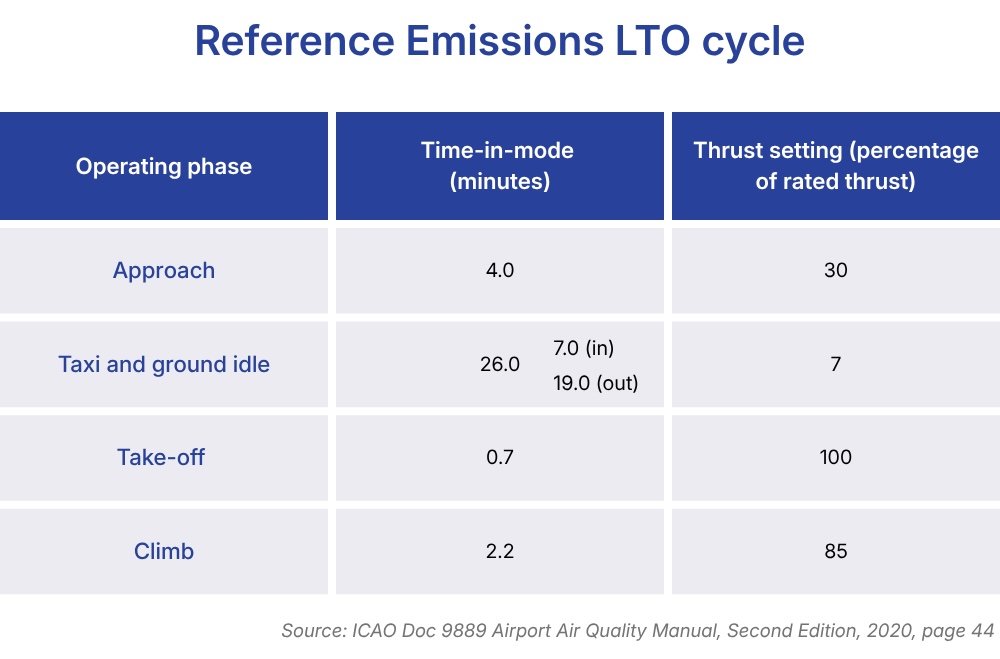
Most ground emissions calculations leverage standard ICAO taxi and ground idle times: 26 minutes, of which 19 minutes are allocated to taxi-out, and 7 minutes are allocated to taxi-in.
Because this time allocation is meant to cover the range of airports in operation, from regional to major hubs, it can over-attribute ground emissions to smaller airports with shorter taxiways.
Consider two airports of differing sizes: the Lisbon and Funchal Airports.

In 2025, the average taxi distance traveled at LIS was 1140m (~3,740ft), while the taxiway at FNC was almost half the length at 635m (~2,083ft).
How, then, could an airport with lower taxi-out times than the ICAO average capture these differences in airport size and taxiway lengths and configurations?
Calculating LTO Emissions with ADS-B inputs
By leveraging ADS-B data and advanced data fusion techniques, Estuaire implements a flight-based approach to calculating LTO emissions.
For each flight, Estuaire retrieves the key components of LTO emissions calculation, meaning: fuel flow, emission factors, and times-in-mode for each phase of an LTO cycle. Currently, only taxi times are derived from ADS-B data, due to its sensitivity, but ADS-B data could inform the full LTO emissions calculations in the future.
Precise taxi times
In order for Estuaire to determine taxi times from ADS-B trajectories, we segment and analyze the aircraft path on the ground, matching it to a detailed airport configuration map. This map identifies the boundaries of aprons, taxiways, and runways.
For Taxi Out, a “timer” starts when the aircraft leaves the apron and stops when it crosses the takeoff runway.
For Taxi In, the “timer” starts when the aircraft leaves the landing runway and stops when it comes to rest near the apron.
Using a 15-second resolution, this ADS-B tracking method allows for precise computation of taxi times for each flight.
In practice
Returning to our two Portuguese airport examples, we see that deriving taxi times for both a hub and small airport have, on average, shorter taxi times than the ICAO average.
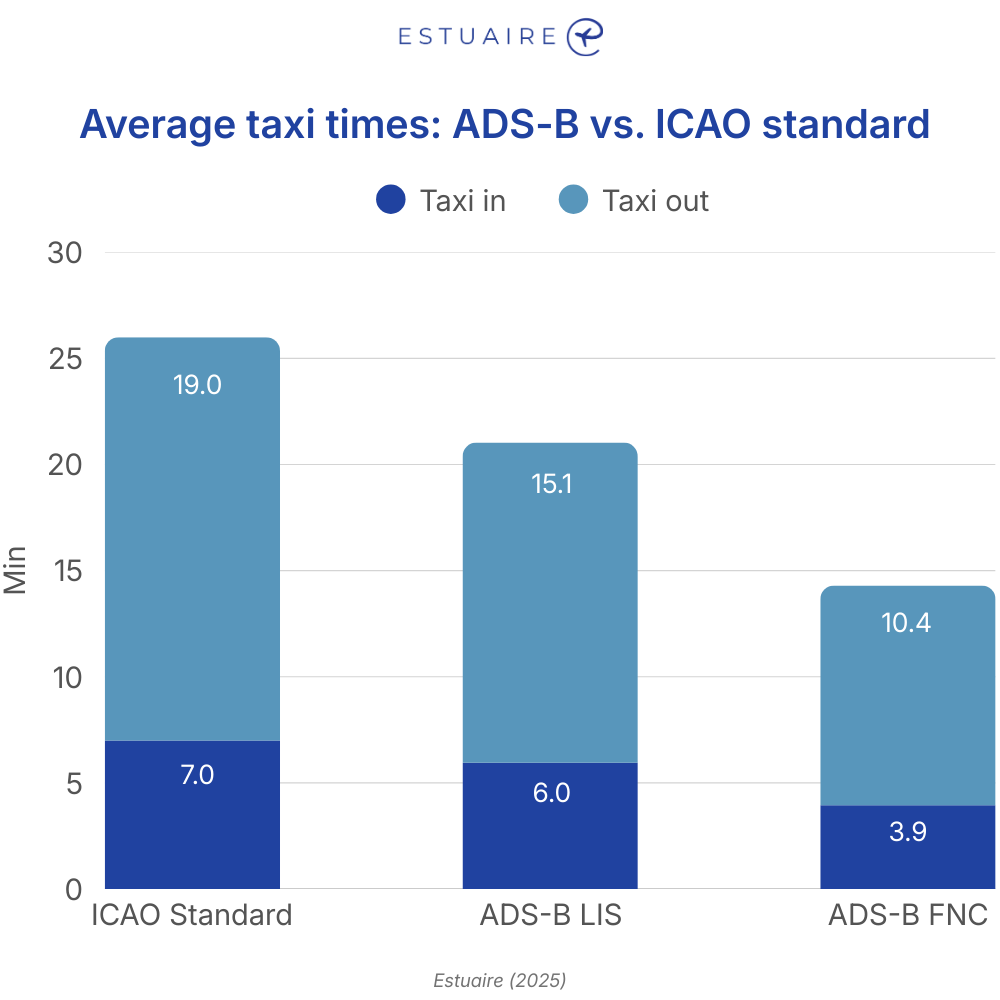
What do the differences in taxi times do to emissions calculations for this phase of the LTO cycle? The result is a 21% difference at LIS and a 58% difference at FNC.
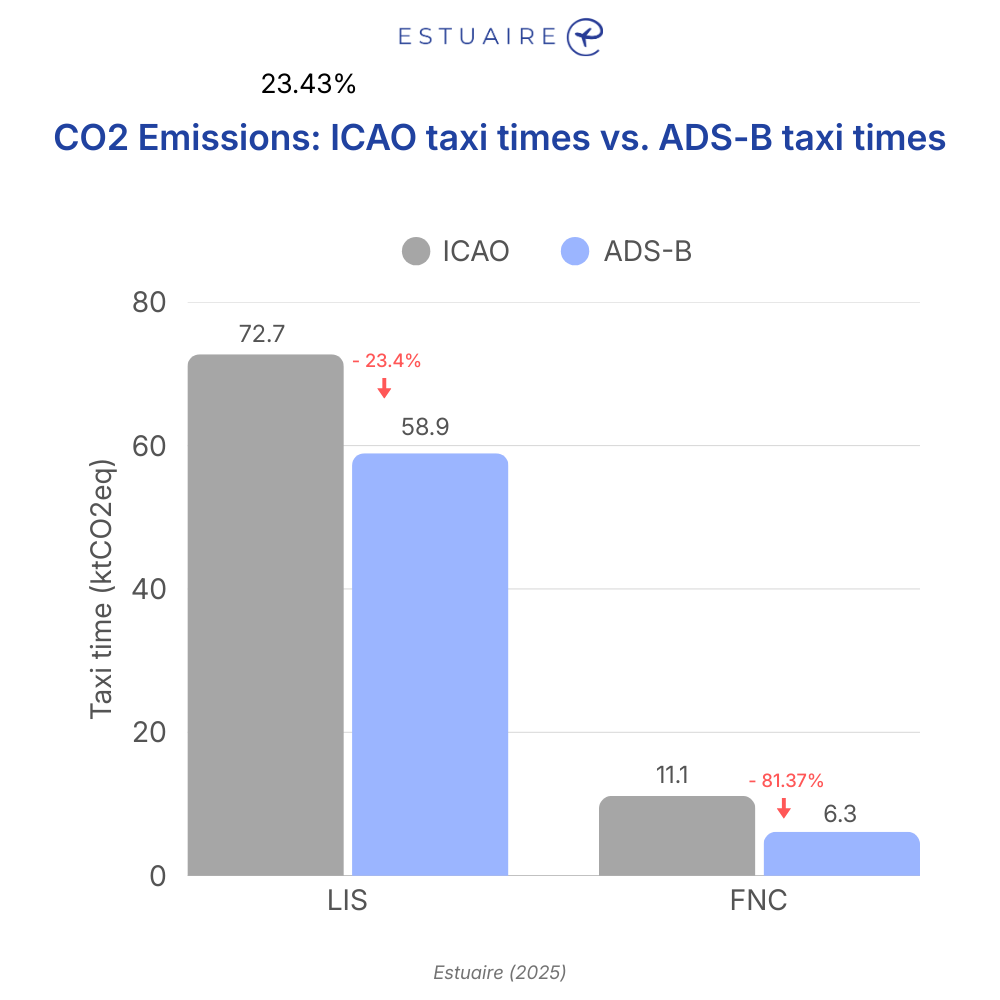
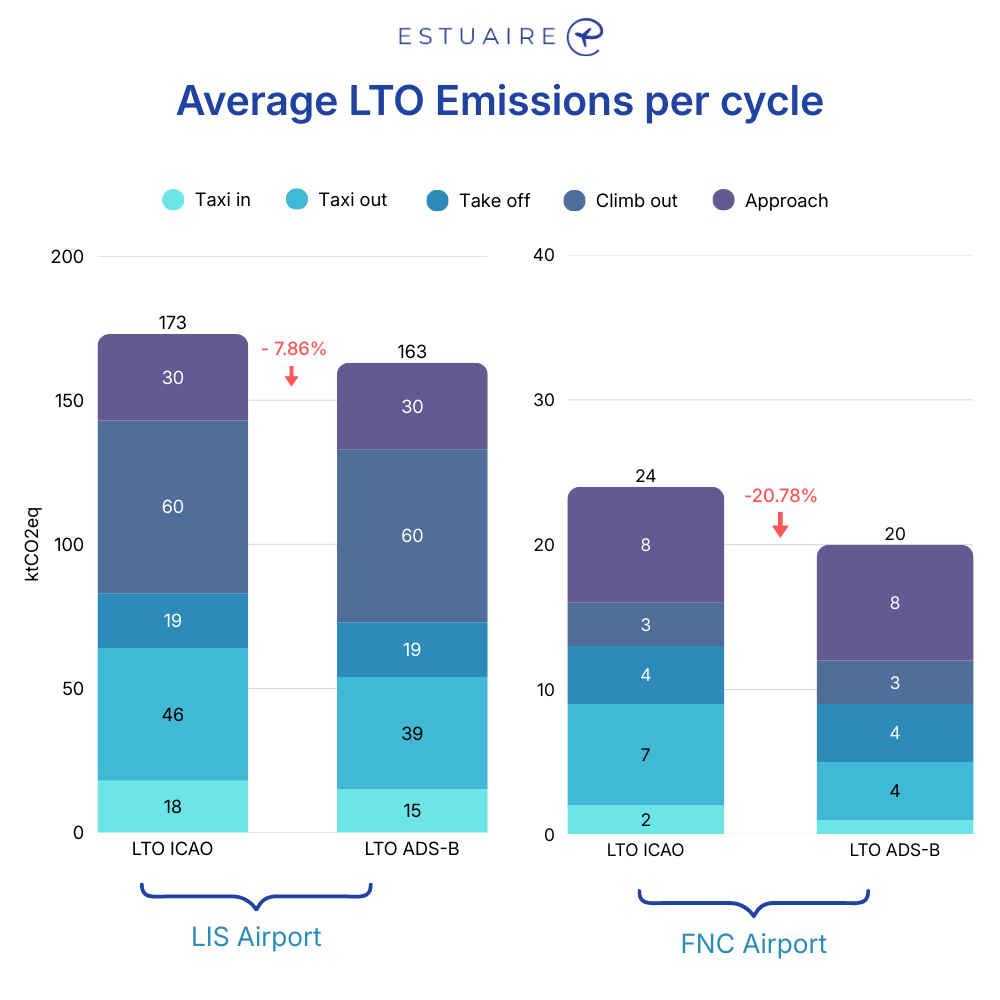
If using ADS-B input data for taxi times has such an impact on emissions calculations, what might we see if we used ADS-B data to time the other phases of the LTO cycle, like climb out and approach?
Implications for Airports
Not only does this approach more accurately calculate ground emissions for an airport, but looking at the data for historical trends can allows the airport to better engage with stakeholders like airlines and the finance community.
With airlines, this could look like sustainability-informed stand allocations or modulating airport charges to incentivize environmental practices.
For strategic capital and infrastructure decisions, this approach allows an airport to see the impact of its initiatives on emissions profiles.
Lastly, airports could access preferred financing schemes linked to environmental metrics like improved LTO emissions intensities or maintenance of Airport Carbon Accreditation (ACA) certification.
Curious to understand the impacts of these methods on your airport? Drop us a line!
.png)
- What is an LTO cycle?
A Landing and Take-Off (LTO) cycle is defined by the International Civil Aviation Organization (ICAO) as all aircraft operations that occur below 3,000 feet. It consists of five operational phases: Taxi out, Take-off, Climb-out, Approach and Taxi in.
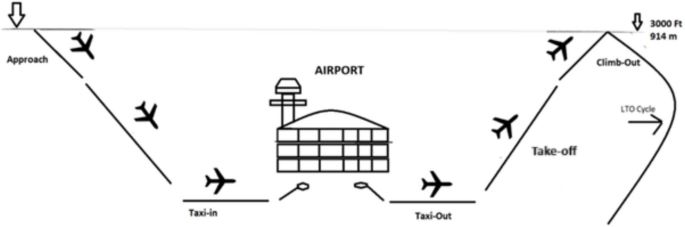
An LTO cycle includes four engine operating modes: idle, take-off, climb-out, and approach. Each mode corresponds to a specific engine thrust setting and a defined time in mode.
The association between operational phases, engine operating modes, thrust settings and the ICAO standard Time-in-Mode is presented as follows:
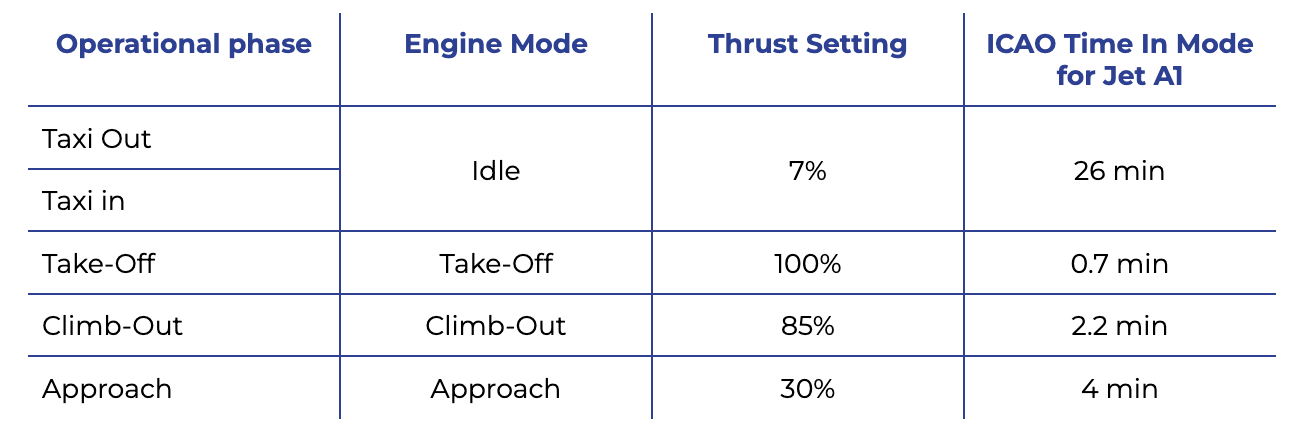
Taxi Out is from gate to liftoff, and Taxi In is from touchdown to gate.
- How do you compute LTO emissions?
LTO emissions represent the total amount of a given pollutant released during the LTO cycle. To calculate these emissions, the accepted method consists of summing the contributions from each operational phase, or “mode,” of the LTO cycle. Time-in-mode, fuel flow, and an emission factor (converting the fuel burned into emissions) are assigned to each mode and pollutant, as described in the following equation:

As a result, for LTO CO2 Emission are computed as such:

A similar calculation approach would be applied to other GHG emissions, such as methane (CH4).
- How do you estimate fuel flow?
For a given LTO cycle, fuel flows depend on the specific engine type mounted on the aircraft. Estuaire matches the fuel flow, or controlled supply of fuel in precise quantities, model from official databases to the engine type for that specific flight.
- How emission factors are used?
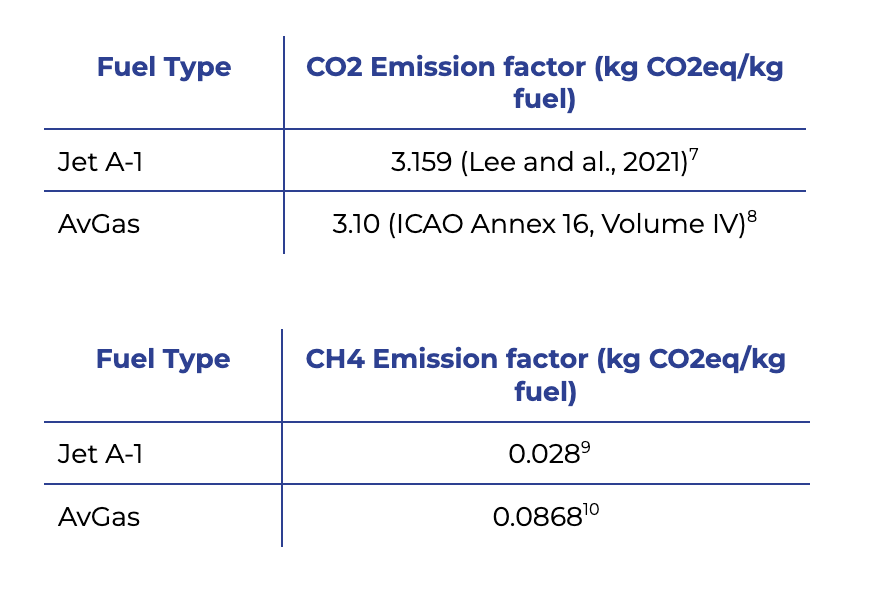
Estuaire computes emissions regarding two types of pollutants: CO2 and CH4. For CO2, Estuaire calculates Tank-to-Wake (TTW) CO2 emissions that result from the direct combustion of Jet A-1 or AvGas. They are computed using the following a TTW emission factor:


.png)