
The aviation industry is currently navigating a significant shift in climate impact management. Starting January 2025, the revised EU ETS Directive 2023/958 mandates that aircraft operators with intra-EEA flights monitor and report non-CO₂ impacts, including contrails. While the climate impact of persistent contrails is substantial, research indicates that roughly 3% of global flights generate 80% of total contrail warming. This concentration presents a high-leverage opportunity for reduction, but the challenge lies in integrating avoidance into a complex operational environment defined by weather uncertainty, capacity constraints, and strict margins.
To help airlines transition from theory to a functional program, Estuaire has developed a technical guide: "How to Make Contrail Avoidance a Success". Drawing on technical analysis and operational experience, it focuses on three pillars of successful mitigation: scientific modeling, feasible trajectory optimization, and clearly defined operational guardrails, treating climate impact as an operational constraint alongside fuel and time.
Here is what the guide provides
- The "3% Strategy" in practice: Why concentrating avoidance efforts on a minority of high-impact flights delivers the most measurable reduction, and how to identify those flights from your own inventory.
- Operational guardrails: How to set objective caps on fuel burn and delay to ensure every rerouting recommendation stays within mission constraints.
- Pre-tactical vs. tactical execution: When to act at dispatch vs. in-flight, and how to deliver rerouting instructions in a format crews can load directly into the FMC.
- Post-flight verification: How to use GOES/MTG satellite data and a defined KPI set to confirm actual climate impact reduction.
The guide also includes a real vertical flight profile showing how an optimizer routes around ice-supersaturated regions while staying within fuel and time budgets.
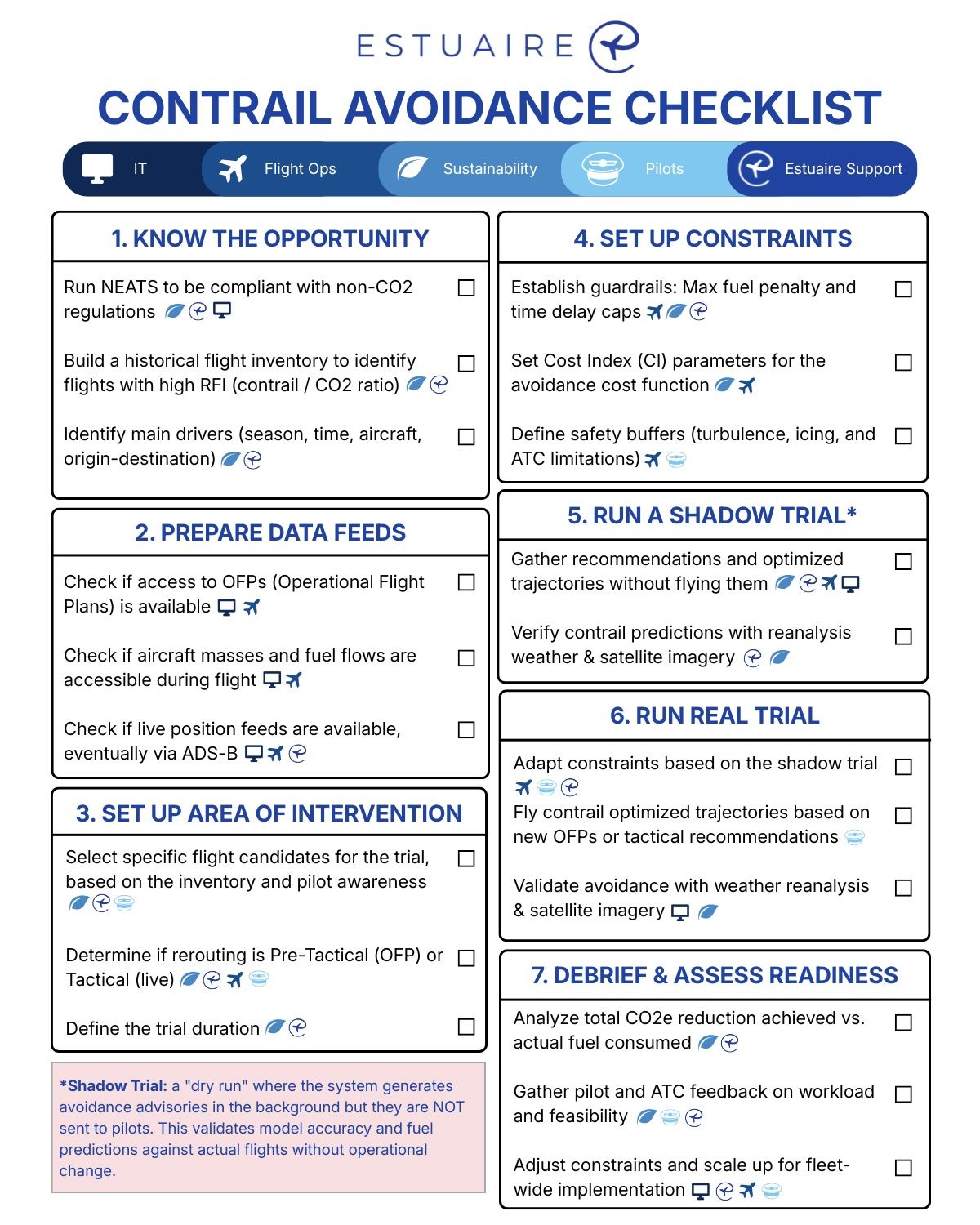
Contrail Avoidance Implementation Checklist
After running trials with multiple airlines, we've seen the same challenges come up every time. That's why we built this practical checklist, to make it as easy as possible for airlines to start this journey. It walks through the 7 phases that make contrail avoidance operational: data validation, constraint setting, shadow trials, real flights, and debrief.
Contrail avoidance is a practical lever available today, but its success depends on the quality of the data and the honesty of the trade-offs made in the cockpit and the operations center.
For a deeper dive into the climate models and operational guardrails mentioned above, download our complete guide "How to Make Contrail Avoidance a Success".


.png)