
On July 17, 2026, the European Commission released a proposal for a targeted revision of the EU ETS. The new proposed changes bring aviation some consequential updates: a wider geographic net, the first-ever mechanism to address non-CO2 climate effects, extended SAF support, and a handful of structural changes that will hit airline compliance costs directly.
Below, we break down each of these changes and run the numbers on what the new contrail provisions could mean for three airlines with very different operating profiles.
Expanded Geographic Coverage
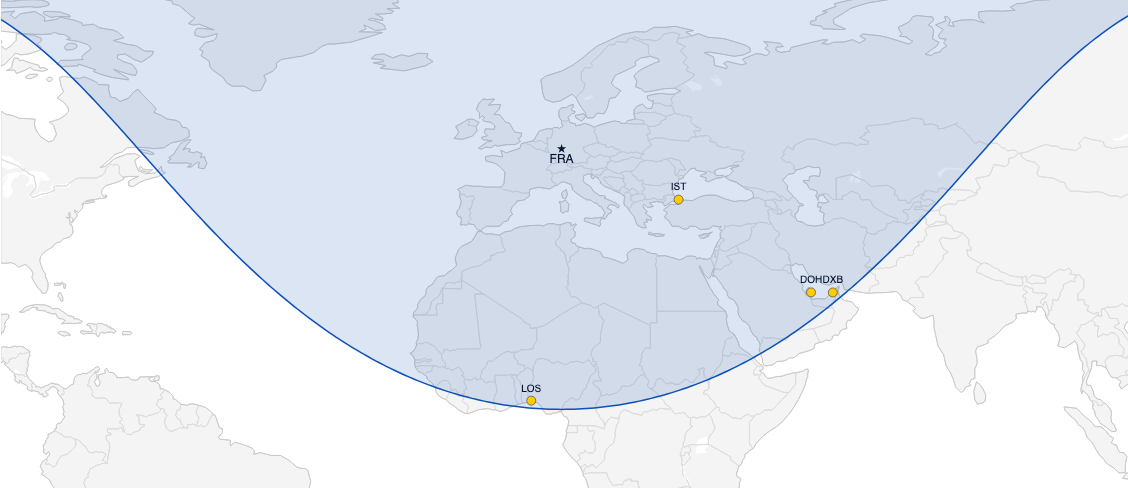
A significant proposed revision to the aviation ETS is the extension of its geographic reach to cover extra-European departing flights. Starting in January 2029, the ETS scope will expand to include flights departing from an EEA airport to third-country destinations within a 5,000 km radius of Frankfurt aerodrome. This targeted extension focuses on long-haul routes most susceptible to "hub leakage" while ensuring that a larger portion of international aviation emissions are subject to a meaningful carbon price.
The big airports that would now fall under ETS will be the Istanbul international airport, Hamad International airport in Doha, Dubai international airport and the Murtala Muhammed International airport in Lagos, Nigeria. However, while this expansion represents a step towards addressing emissions beyond the EU's borders, it still misses major global markets, including the United States, China, and the vast majority of Asia. Because these destinations largely fall beyond the 5,000 km threshold, they remain exempt from surrendering allowances until at least 2032, leaving a substantial portion of the world's fastest-growing aviation emissions outside the system's immediate reach.
The First Non-CO2 Mechanism: Contrails
This marks the first time the proposal tackles aviation's non-CO2 climate effects, with contrails as the main target.
A dedicated pool of up to 3 million allowances is set aside through the end of 2033 to incentivize contrail reduction, with no more than 420,000 of those allowances allocated in any single year.
Airlines that embed contrail forecasting models into their flight planning systems, and make those forecasts available to their operations control centre for assessment and incorporation into flight planning where operationally viable, will be allocated allowances equal to 0.1% of their verified emissions.
Airlines can also be allocated allowances corresponding an additional 0.02% of verified emissions if they actual flight data for flight trajectories and fuel flow to report non-CO2 effects as part of the MRV.
The forecasting models also need to run on the same reference weather prediction model and data the Commission uses in its own MRV tools (DWD ICON model used in NEATS).
What’s notable about the new proposal is that it puts a price, for the first time, on building the forecasting and reporting capability that any serious contrail avoidance strategy will eventually depend on. Once airlines have real forecasts checked against real flight trajectories and fuel flow data, the path to genuine avoidance strategies gets a lot shorter. This mechanism lays that foundation, so airlines won't be scrambling when avoidance requirements get pushed further.
Robust Support for Sustainable Aviation Fuels (SAF)
The revision extends the availability of reserved allowances for Sustainable Aviation Fuels (SAF) and alternative propulsion until December 31, 2040. A maximum of 110 million additional allowances will be reserved to help airlines bridge the price gap between conventional fuel and more expensive sustainable alternatives. The financial support is tiered: the ETS can cover 60% of the price differential for renewable hydrogen and synthetic fuels, 50% for advanced biofuels, and 100% for fuels delivered to airports on small islands or in outermost regions.
Other Changes
Two other changes are worth flagging. The proposal brings business aviation into the system, closing the gap that previously let private jets operate outside the ETS. On the other end, smaller and low-activity operators should get relief through administrative simplification: the Commission is introducing simplified monitoring and reporting tools, including options populated directly with Eurocontrol data, to cut down the regulatory burden for those least equipped to absorb it.
Case study
With contrail avoidance now built into the ETS, it's worth looking at what adoption could actually mean for airlines financially. We picked three carriers with different operating models to see how the impact varies:
- European legacy: Iberia (Iberia LAE, Iberia Express)
- European low-cost: Ryanair (RyanAir DAC, Malta Airlines, RyanAir UK limited, Buzz Airlines)
- International cargo: DHL (European Air Transport Leipzig, DHL Air Limited, DHL Aviation)
Ryanair's high-frequency, short-haul model shows the upside for high emitting carriers; Iberia, as an European legacy carrier, shows a more typical case; and DHL isolates the impact of the new geographic extension on international cargo operations.
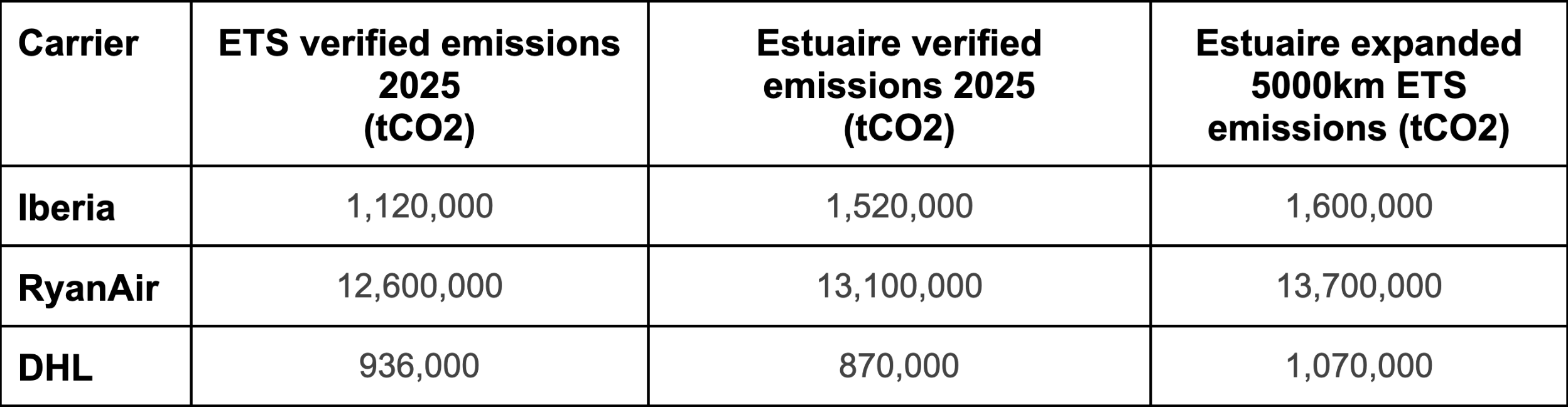
Table 1 provides the data of the official 2025 EU-ETS verified emissions along with the emissions as tracked in Estuaire’s database and projection of increased emissions after the 5000km range increase. The reason for discrepancy between Estuaire data and ETS for 2025 could arise from operator attributions, different carriers and their subsequent AOC holders can lead to over or underestimation in individual cases, that said the orders of magnitude are consistent across the two sets with limited differences.
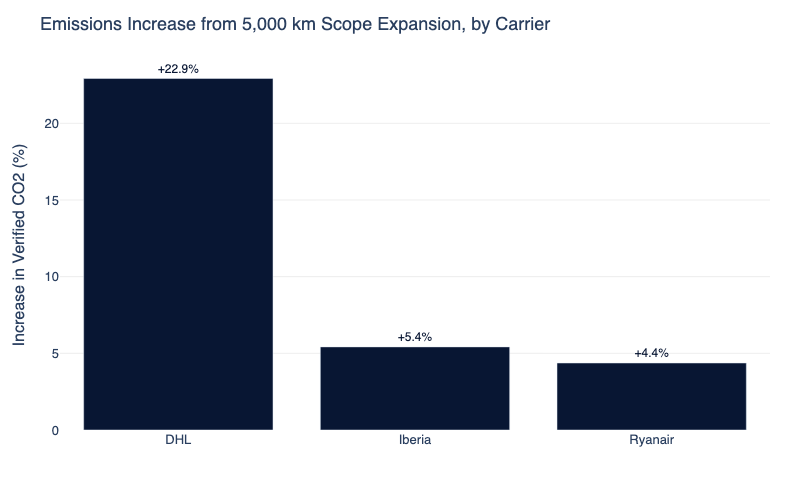
We applied the extended geographic coverage and the new contrail reporting provisions to each airline's 2025 operations and emissions to estimate their verified emissions under the revised rules. Figure 2 shows the difference in growth of verified emissions between these operators.
The value for an Allowance is priced at €80/tCO2eq (taken as average from previous months price trends) for this case study. We calculated the base allocation each airline would be entitled to with 0.1% of the new verified emissions, assuming they integrate contrail forecasting into flight planning and share it with their ops control centre as the proposal requires and further add the 0.02% data monitoring bonus.
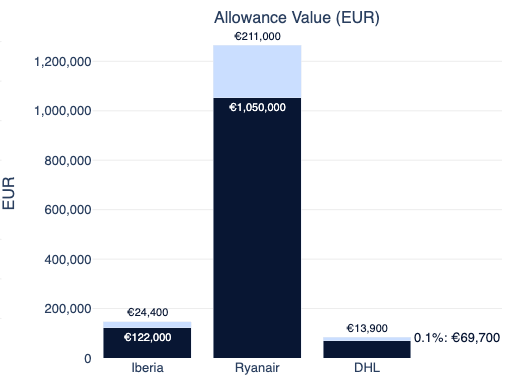
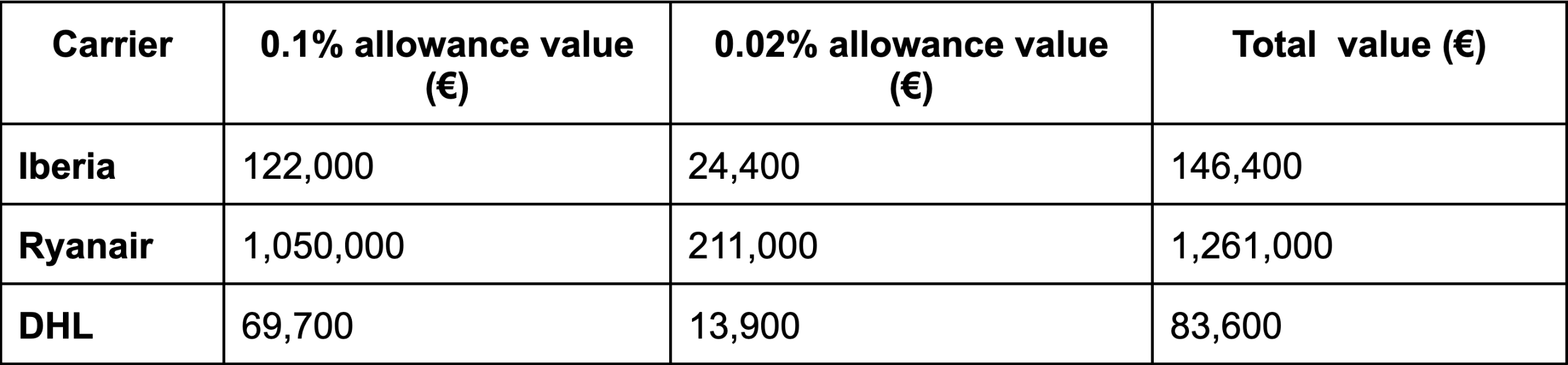
Ryanair comes out as the clearest winner: its high-frequency, short-haul model translates into an estimated €1.2 million in allocated allowances, just for adopting a monitoring system that would not require much additional resources. Iberia and DHL see smaller gains, given their different route structures and emissions profiles, but both still stand to recover a meaningful sum for what amounts to a relatively low-effort integration.
Taken together, these changes push the aviation ETS further: geographically, through the extension to third-country long-haul routes, and substantively, through the first real attempt to price in non-CO2 warming effects. The contrail scheme is structured to reward operators for adopting forecasting tools they likely already have the technical capacity to deploy, making it one of the more accessible provisions in the package. Geographic expansion and extended SAF support will matter more in raw compliance-cost terms, but the contrail scheme sets a precedent: non-CO2 effects are now inside the regulatory conversation, not just the scientific one. Whether the mechanism eventually evolves from reporting incentives into something closer to avoidance requirements is an open question, but for airlines, the smart move is to start building that capability now rather than waiting to be told to.
.png)
- European Union allowance: A permit granting the right to emit one tonne of CO2 under the EU ETS. Companies can buy, sell, or trade EUAs with each other, and the total number issued is capped and reduced over time to push emissions down.
- DWD ICON: is the numerical weather prediction model developed by DWD, Germany's national weather service. It's the reference model the European Commission uses in its own MRV tools, including for contrail forecasting.
- SAF (Sustainable Aviation Fuel) : Aviation fuel produced from renewable or waste feedstocks that can substitute for conventional jet fuel, typically at a higher cost.
- MRV (Monitoring, Reporting, Verification) : The framework airlines use to track and report emissions data for compliance with schemes like the ETS.


.png)