
As ESG requirements grow more stringent, aviation stakeholders need increasingly detailed data to calculate and monitor airline carbon footprints.
One data point is becoming particularly relevant: how much Sustainable Aviation Fuel (SAF) an airline actually uses and how it is accounted for.
The challenge is that SAF data is fragmented. Airlines publish information in different formats and with different levels of detail. At the same time, an increasing share of SAF use is driven by regulatory mandates, making total SAF volumes alone less informative.
Estuaire's new SAF dataset, covering 21 airlines, brings these different data sources together with its own database to contextualize the information ; distinguishing the share of SAF used to meet regulatory mandates from the share used voluntarily, beyond what is required.
Why voluntary SAF data matters
For all the players across the aviation sector; financial institutions to airports and aircraft and engine manufacturers.., calculating asset-related emissions, airlines’ fuel consumption is a key part of the calculation. But assuming that all fuel consumed is conventional jet fuel does not reflect the full picture when an airline uses SAF.
Total SAF use also needs to be interpreted carefully.
Part of an airline's SAF consumption may be linked to applicable mandates, while another part results from voluntary procurement — whether driven by the airline's own commitment to decarbonization or by its passengers' willingness to pay for it.. Distinguishing between the two provides a more precise view of an airline's fuel mix and decarbonization efforts.
This can support:
- More representative airline carbon footprint calculations
- Financed emissions assessments
- Airline and portfolio comparisons
- Analysis of SAF deployment over time
Methodology: How the SAF Dataset was built
The dataset combines three types of information.
1. Publicly reported SAF data
We reviewed airline disclosures published from 2024 to 2026 to identify reported SAF use across the 21 airlines covered by the dataset.
Reported SAF volumes are not always presented in the same way. Some disclosures combine voluntary SAF use with mandated volumes, while others provide only a global figure. In these cases, determining whether the reported volume already includes the mandated component is essential to avoid double counting. Where possible, we reviewed the underlying disclosures to establish this distinction and converted the figures into kilotons per year for consistency.
2. SAF mandate data
We use the SAF mandate data available on the Estuaire platform to identify the requirements that apply to each airline. This gives us an estimate of the SAF volumes linked to regulatory requirements.
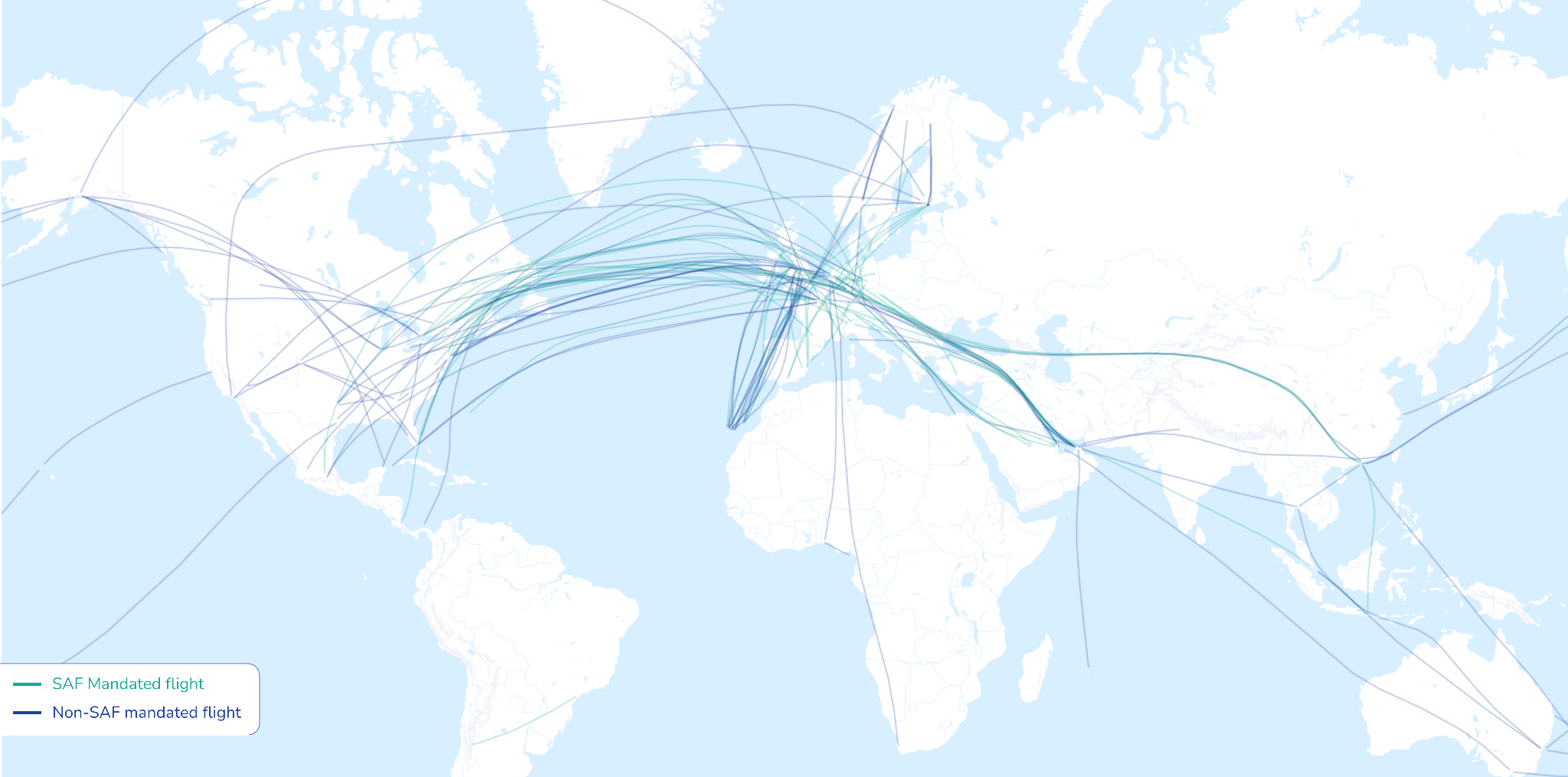
3. Estimated voluntary SAF use
We calculate voluntary SAF use by subtracting the SAF volume required under mandates from the total SAF volume reported by each airline:
Voluntary SAF = Total SAF − Mandated SAF
Where needed, we also use operational and fuel consumption data to check the figures against the airline's level of activity.
These results are estimates based on publicly available information and the methodology applied. Because airline disclosures vary in format and level of detail, the same approach is applied across all 21 airlines to make the data easier to compare.
Voluntary vs mandated SAF
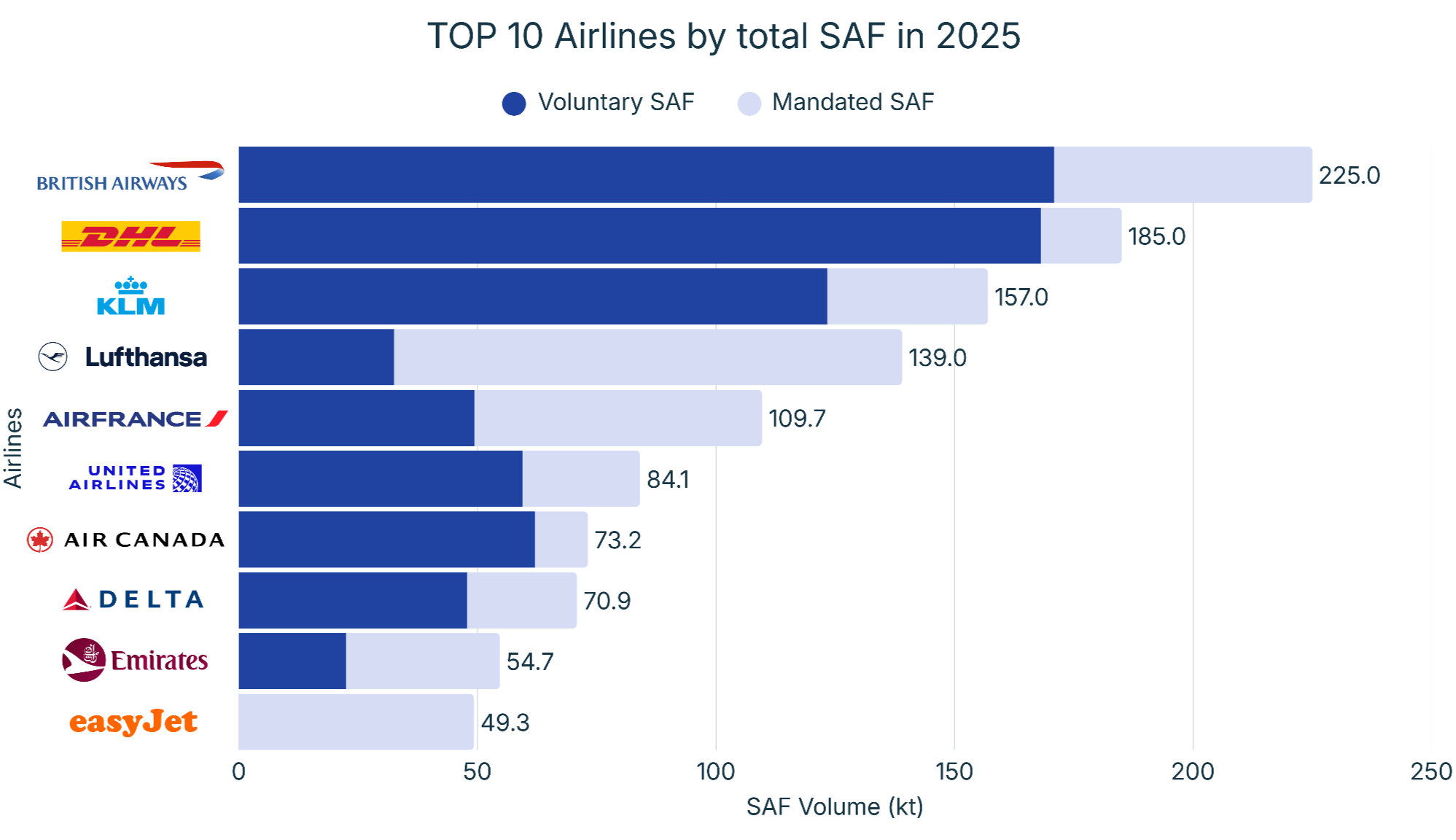
The preview shows significant differences in how airlines are meeting their SAF volumes. Some airlines report substantial voluntary procurement alongside mandated volumes, while others rely more heavily on regulatory requirements. DHL, for example, reports a much larger volume of voluntary SAF than mandated SAF, while Lufthansa shows the opposite pattern.
Total SAF growth
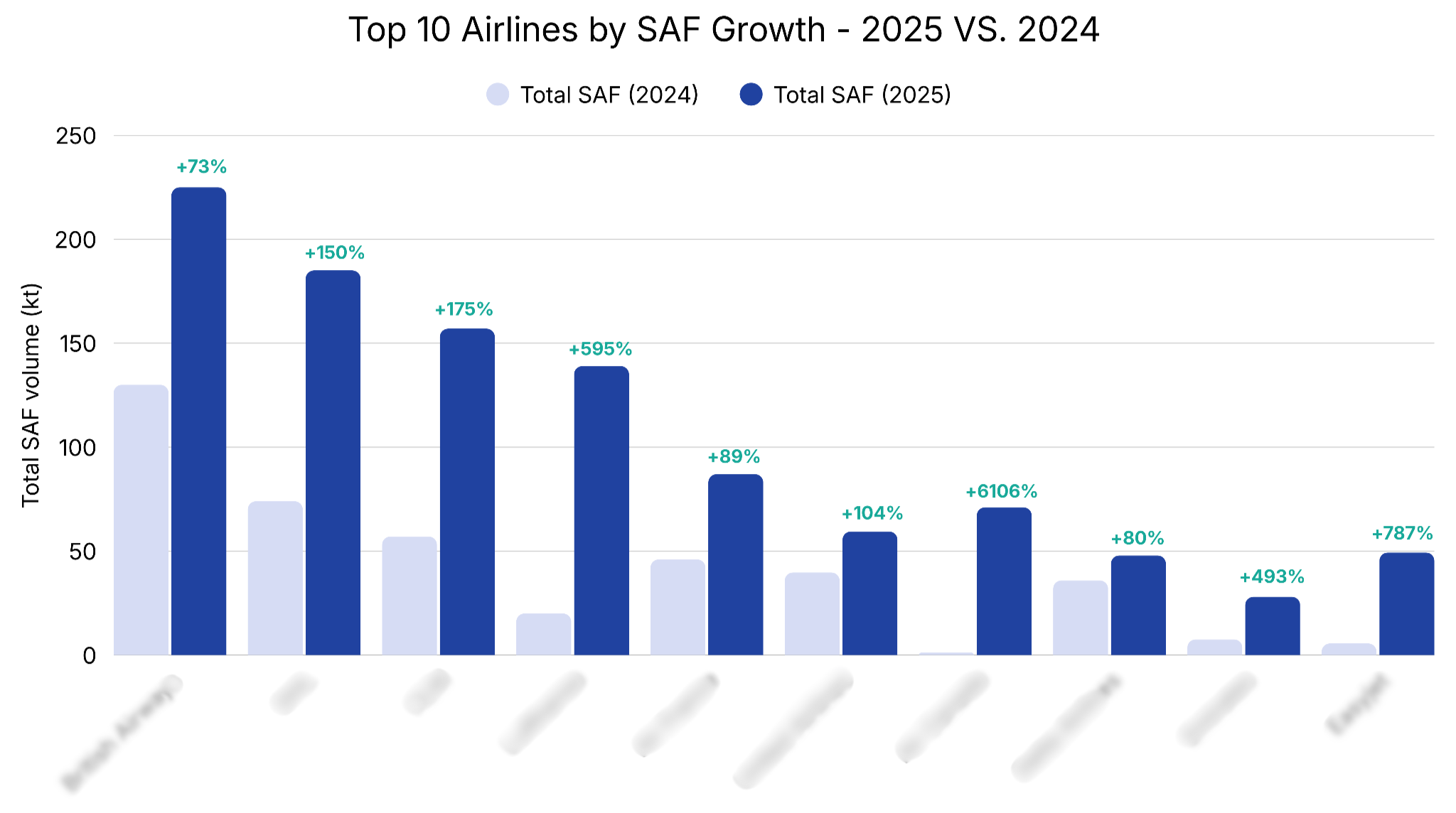
The comparison highlights how quickly SAF volumes are evolving across the industry.
A strong growth in total SAF volumes is noticed across most of the airlines covered. British Airways, DHL, Lufthansa and KLM recorded some of the largest increases between 2024 and 2025, while several airlines reported smaller but still notable increases.
The charts below offer a snapshot of this variation across airlines, with the full dataset providing a broader view of SAF volumes and procurement patterns.
The Voluntary SAF dataset is available as a free resource, including the data and methodology behind the analysis.
.png)
What is SAF?
Sustainable Aviation Fuel (SAF) is a cleaner alternative to regular jet fuel made from waste materials like used cooking oil or garbage instead of crude oil.
It mixes perfectly with normal fuel, so airlines can use it in existing airplanes and airport pipes without changing any equipment. SAF helps the planet because it recycles existing carbon rather than pumping new fossil fuels into the atmosphere.
Mandated SAF vs. Voluntary SAF
- Mandated SAF: Fuel that airlines are legally forced to use by government regulations. Fuel suppliers face strict fines if they do not provide the required amount.
- Voluntary SAF: SAF purchased by airlines beyond regulatory requirements, typically to meet their own climate targets or to offer lower-emission options to passengers and cargo customers.
What are SAF Mandates?
SAF mandates are laws that require fuel suppliers, or in some countries airlines, to include a minimum share of sustainable aviation fuel in the jet fuel supplied at airports.
Several countries have introduced their own versions, but the most prominent are the European Union's ReFuelEU Aviation regulation and the United Kingdom SAF Mandate. Both mandates increase over time:
- The ReFuelEU blending mandate obligates fuel suppliers to blend increasing amounts of SAF into jet fuel, starting at 2% in 2025 and rising to 34% by 2040 and 70% by 2050.
- The UK mandate starts in 2025 at 2% of total UK jet fuel demand, increasing linearly to 10% in 2030 and then to 22% in 2040.
One structural difference: under the UK scheme, suppliers receive certificates in proportion to the level of GHG emission reductions their fuel delivers, whereas ReFuelEU counts SAF volume only.
ReFuelEU & UK SAF mandate 2025 data
Suppliers delivered 39.3 Mt of aviation fuel at EU airports in 2025, of which 1.1 Mt (2.8%) was SAF, above the 2% minimum. Aviation biofuels supplied achieved an average GHG emission reduction of around 90% compared with fossil jet fuel.
Source : ReFuelEU Aviation Annual Technical Report 2026
In the UK, provisional data put SAF at 2.28% of jet fuel delivered, with final figures due in November 2026.
Source : UK SAF Mandate : fifth provisional report for 2025
SAF mandates vs FEETS (EU ETS support for eligible aviation fuels)
FEETS - better known as SAF free allowances - helps airlines pay for the SAF premium, whether that SAF is voluntarily consumed or not. Created by the 2023 EU ETS revision, it provides 20 million free allowances (about €1.5bn) from 2024 to 2030, to cover all or part of the price gap between fossil kerosene and SAF on ETS-covered flights.
In 2025, around 5.2 million allowances worth roughly €430m went to 130 operators. The two work together: the mandate creates supply, FEETS offsets its cost.
Source : Official list of ETS FEETS operators and associated volumes (2025)
.png)
